
企业出海最贵的成本,不是机票和展位,而是"信息不对称" The Most Expensive Cost of Going Overseas Is Not Flights or Booths – It Is Information Asymmetry
3 August 2026
出海最大的成本往往不是机票、展位、样品这类可见费用,而是"信息不对称"。当企业不清楚目的国规则、误判当地需求、找错合作伙伴时,付出的代价远高于一场展会。本文梳理了信息不对称带来的五类后果(决策错误、投入浪费、合规风险、信任受损、机会错失),并提出五项降低风险的方法(基础市场了解、产品适配判断、合作伙伴背景尽调、合规问题前置、借助平台与专业机构)。ARFF中国运营中心希望通过持续的内容与基础咨询,成为中国企业进入东盟市场的"稳定信息入口"。 The biggest cost of going overseas is rarely the visible kind – flights, hotel stays, booth rentals, samples, logistics – but rather the "invisible cost of information asymmetry". When companies fail to grasp destination-market regulations, misjudge local demand, or choose the wrong partners, the price paid far exceeds that of any trade fair. This article outlines five consequences of information asymmetry – wrong decisions, wasted investment, compliance risk, damaged trust, and missed opportunities – and proposes five ways to mitigate it: a baseline understanding of the market, product-fit assessment, partner due diligence, front-loading compliance, and leveraging platforms and professional institutions. ARFF China Representative Office aims to serve Chinese enterprises as a stable information gateway into the ASEAN market through ongoing content and advisory support.
导语 / Lead
出海真正的成本,往往不是参加一次展会、飞一趟海外、拜访几个客户,而是在信息不清、规则不明、伙伴不准的情况下不断试错。
The real cost of going overseas rarely lies in attending a trade fair, flying abroad, or visiting a few clients. It lies in repeatedly trial-and-erroring under conditions of unclear information, unclear rules, and unclear partners.
很多企业准备进入东盟市场时,首先计算的是看得见的成本: 机票、酒店、展位、样品、物流、翻译、商务接待。
When many companies prepare to enter the ASEAN market, the first thing they calculate is the visible cost: flights, hotels, exhibition booths, samples, logistics, translation, and business reception.
这些成本当然需要计算。 但真正让企业付出高代价的,往往不是这些看得见的费用,而是看不见的信息不对称。
These costs certainly need to be calculated. But what really makes companies pay a high price is rarely these visible expenses – it is the invisible information asymmetry.
信息不对称,会让企业在不该投入的地方投入,在不该相信的人身上相信,在不该承诺的事项上提前承诺。
Information asymmetry causes companies to invest where they should not, to trust those who should not be trusted, and to make commitments that should not be made prematurely.
一、不知道规则,容易走弯路
I. Not Knowing the Rules Leads to Detours
每个市场都有自己的规则。 产品能不能进口?是否需要认证?标签是否合规?清关是否有特殊要求?是否涉及清真、医疗、食品、建材、电器、环保等行业监管?
Every market has its own rules. Can the product be imported? Is certification required? Are the labels compliant? Are there special customs-clearance requirements? Do sectors such as halal, medical, food, building materials, electrical appliances and environmental protection come into play?
如果这些问题前期不清楚,后面可能出现: 产品进不去;货物被扣留;标签需要重做;合同无法履行;合作成本大幅增加。
If these questions are not clarified at an early stage, the following may happen later: products cannot be imported; goods are detained; labels need to be redone; contracts cannot be fulfilled; cooperation costs rise sharply.
规则不清,是企业出海最常见的隐性成本。
Unclear rules are the most common hidden cost when Chinese enterprises go overseas.
二、不了解市场,容易误判需求
II. Not Understanding the Market Leads to Demand Misjudgment
很多企业习惯用国内经验判断海外市场。
Many companies are used to using their domestic experience to judge overseas markets.
但一个产品在中国能卖,不代表在马来西亚或其他东盟国家一定有市场。
But the fact that a product sells well in China does not mean it will necessarily have a market in Malaysia or other ASEAN countries.
当地消费者的价格接受度、品牌认知、宗教文化、使用习惯、渠道结构,都可能不同。
Local consumers' price acceptance, brand awareness, religious culture, usage habits, and channel structure may all differ.
有的企业以为自己产品有优势,到了当地才发现: 价格没有竞争力;包装不适合;渠道不匹配;客户需求并不强;售后要求更高;竞争对手已经很多。
Some companies believe they have a competitive product, only to discover on arrival that: their price is uncompetitive; the packaging is unsuitable; the channels do not match; customer demand is weak; after-sales requirements are higher; and competitors are already numerous.
市场误判,比没有客户更危险。 因为它会让企业在错误方向上持续投入。
Market misjudgment is more dangerous than having no customers at all – because it keeps the company investing in the wrong direction.
三、伙伴判断不准,风险更大
III. Misjudging Partners Carries Even Greater Risk
海外市场最复杂的,往往不是市场本身,而是合作伙伴的选择。
In overseas markets, the most complex element is often not the market itself but the choice of partners.
有些人说自己有渠道。有些人说自己有政府资源。有些人说自己能包办认证。有些人说自己能马上带来订单。
Some say they have channels. Some say they have government connections. Some say they can handle certification. Some say they can deliver orders immediately.
企业需要谨慎判断: 对方是否有真实公司主体?是否有过往案例?是否有履约能力?是否要求过高前期费用?是否要求排他代理?是否把复杂问题说得过于简单?
Companies need to judge carefully: does the counterparty actually have a registered entity? Does it have a track record? Does it have the capacity to deliver? Does it demand excessive upfront fees? Does it insist on exclusive agency rights? Does it explain complex issues as overly simple?
真正可靠的合作伙伴,不怕把问题讲清楚。
A truly reliable partner is not afraid to spell out the problems clearly.
越是承诺过满,越要谨慎。
The fuller the promise, the more caution is required.
四、信息不对称会带来哪些后果?
IV. What Consequences Does Information Asymmetry Bring?
主要有五类: 决策错误:选择了不适合的市场; 投入浪费:在错误渠道和错误伙伴上花钱; 合规风险:产品、合同、税务、认证出问题; 信任受损:客户体验不好,品牌受影响; 机会错失:真正适合的路径反而没有推进。
There are mainly five consequences:
Wrong decisions – choosing markets that are not suitable;
Wasted investment – spending money on the wrong channels and the wrong partners;
Compliance risk – problems with products, contracts, taxation, certification;
Damaged trust – poor customer experience that hurts the brand;
Missed opportunities – failing to pursue the paths that are genuinely suitable.
企业出海要降低成本,首先要降低信息不对称。
For Chinese enterprises going overseas, lowering cost must begin with lowering information asymmetry.

五、如何降低信息不对称?
V. How Can We Lower Information Asymmetry?
第一,先做基础市场了解 不要只听单一渠道的信息,多方交叉验证。
First, build a baseline understanding of the market. Do not rely on a single information channel – cross-verify across multiple sources.
第二,先做产品适配判断 不要一开始就大量发货,先做样品测试、渠道反馈和价格测算。
Second, make a product-fit assessment. Do not start by shipping large volumes – begin with sample testing, channel feedback, and price calculations.
第三,先做合作伙伴背景了解 对重点合作方,要看主体、资质、案例、团队和合同条件。
Third, conduct partner due diligence. For key partners, look at corporate identity, qualifications, track record, team, and contract terms.
第四,先把合规问题前置 涉及认证、准入、清真、食品、安全、环保等问题时,不能后置处理。
Fourth, front-load compliance issues. When certification, market access, halal, food safety, environmental protection and similar issues are involved, do not leave them to be resolved at the end.
第五,借助平台和专业机构 商协会平台、产业园区、专业服务机构、本地合作伙伴,都可以帮助企业减少盲区。
Fifth, draw on platforms and professional institutions. Chamber-of-commerce platforms, industrial parks, professional service providers, and local partners can all help enterprises reduce blind spots.
六、ARFF中国运营中心的价值
VI. The Value of ARFF China Representative Office
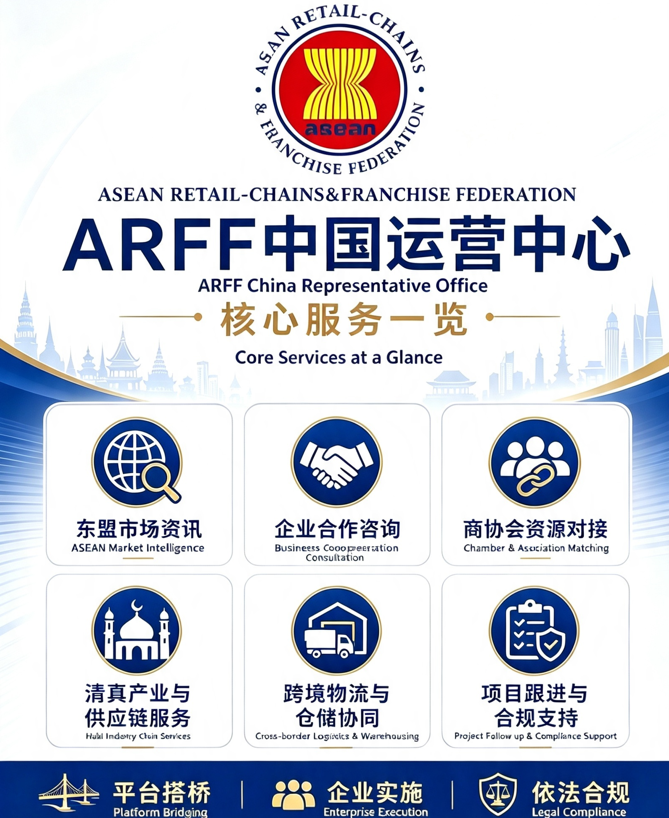
ARFF中国运营中心希望通过持续内容发布和基础咨询服务,帮助企业减少东盟市场的信息不对称。
ARFF China Representative Office hopes to help enterprises reduce information asymmetry in the ASEAN market through continuous content publication and basic advisory services.
我们将重点围绕: 马来西亚及东盟市场观察; 企业出海常见问题; 零售连锁与特许经营资讯; 清真产业与供应链基础认知; 商协会资源对接; 企业合作咨询与线索跟进; 为企业提供更稳定的信息入口。
We will focus on:
Malaysia and ASEAN market observations;
Common questions for Chinese enterprises going overseas;
Retail-chain and franchise intelligence;
Foundational knowledge of the halal industry and supply chain;
Resource matching through chambers of commerce;
Cooperation consultation and lead follow-up; to provide enterprises with a steadier information gateway.
我们不能替企业承诺结果,但可以帮助企业少一些盲目,多一些判断。
We cannot promise outcomes on behalf of any enterprise, but we can help them be less blind and more discerning.
结语 / Closing
企业出海,最怕的不是投入,而是盲目投入。
For Chinese enterprises going overseas, what is most feared is not investment itself, but blind investment.
真正降低成本的方法,不是少花钱,而是把钱花在正确方向上。
The real way to lower cost is not to spend less, but to spend in the right direction.
先看懂市场,再选择路径; 先识别风险,再推进合作。
First understand the market, then choose the path; first identify the risks, then advance cooperation.
信息越清楚,出海越稳。
The clearer the information, the steadier the journey.